$1,000,000 Acquisition in Los Angeles, CA

1031 Exchange Financing:
How Rubicon Mortgage Fund, LLC Closed a
Complex Drive-Through Acquisition in Los Angeles
Loan Amount: $1,000,000
Loan Term: 12 Months
LTC: Under 60%
Lien Position: 1st Deed of Trust
Acquiring income-producing real estate through a 1031 exchange can be one of the most powerful tax-deferral strategies available to real estate investors. But when the right property comes along, speed, diligence, and a lender who truly understands the asset are everything. This case study examines a recent $1,000,000 bridge loan closed by Rubicon Mortgage Fund, LLC for the acquisition of a freestanding, drive-through restaurant property in Los Angeles, California, and how Rubicon’s thorough underwriting process ultimately protected both its investors and its borrower.
What Is a 1031 Exchange? A Quick Primer for Real Estate Investors
A 1031 exchange, named after Section 1031 of the Internal Revenue Code, allows real estate investors to defer capital gains taxes when they sell an investment property and reinvest the proceeds into a “like-kind” replacement property. For active investors building wealth through real estate, this tool is invaluable: it allows capital to keep compounding rather than being eroded by a significant tax event.
However, 1031 exchanges are governed by strict timelines. The investor must identify a replacement property within 45 days of the sale of the relinquished property and must close on the replacement property within 180 days. These deadlines create real pressure — and that pressure makes having a reliable, fast-moving lending partner essential.
Key 1031 Exchange Requirements:
Identify replacement property within 45 days. Close on the replacement within 180 days. The replacement property must be of equal or greater value than the relinquished property. Proceeds must be held by a qualified intermediary, the investor cannot take constructive receipt of the funds.
The Property and the Opportunity
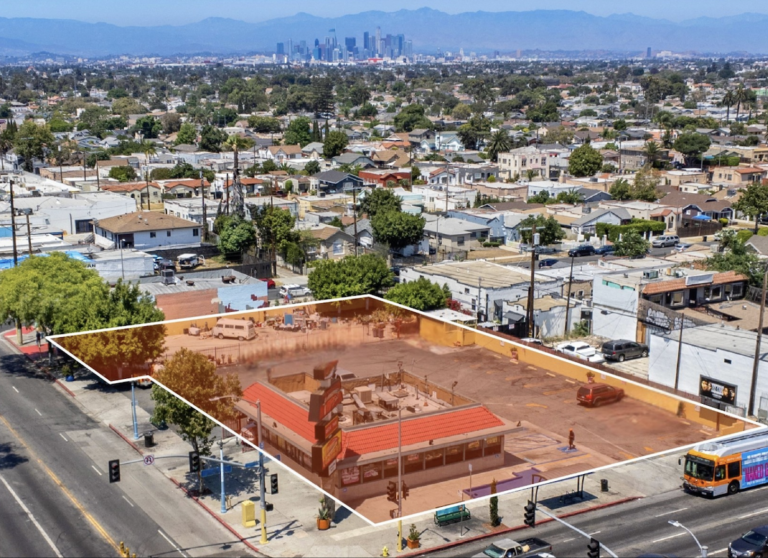
This acquisition involved a freestanding drive-through restaurant situated on a 14,249 square foot parcel along a high-traffic main thoroughfare in Los Angeles. The property benefits from strong visibility, consistent daily foot and vehicle traffic.
The borrower was an experienced real estate investor with an existing portfolio, acquiring this asset as part of a 1031 exchange strategy. They were not starting from scratch: they understood the asset class, the market, and the value of income-producing retail real estate.
Equally important was the tenant profile. The existing tenant, an operator experienced in running multiple similar quick-service restaurant locations, was in the process of renewing their lease. This speaks to both the quality of the real estate and the commercial viability of the operation. A tenant with a proven track record in this format, re-committing to this specific location, adds a meaningful layer of stability to the investment thesis.
Why Drive-Through Restaurant Properties Are Compelling Assets
Freestanding, drive-through quick-service restaurant (QSR) properties have long been coveted in the net lease investment space. Their appeal lies in several factors:
- High-credit, nationally or regionally recognized tenants with long operating histories
- Drive-through infrastructure creates a significant barrier to relocation, as tenants have invested heavily in the site
- Located on high-visibility, high-traffic corridors, exactly the kind of exposure that sustains consumer-facing businesses
- Consistent consumer demand: quick-service restaurants have historically demonstrated resilience even in economic downturns
The Challenge: Environmental Due Diligence on a Former Gas Station Site
From the outset, this was envisioned as a tight, time-sensitive close – a 30-day target that is not uncommon in competitive 1031 exchange acquisitions where the borrower is working against the clock.
However, during the underwriting process, Rubicon’s team identified a critical factor: the property had previously operated as a gas station. For any experienced commercial lender, this is a flag that demands attention. Former gas station sites carry the potential for underground storage tank (UST) contamination, petroleum hydrocarbon exposure, and other environmental conditions that can have significant legal, financial, and operational implications for a new property owner.
Why Former Gas Station Sites Require Extra Scrutiny:
Residual contamination from underground storage tanks (USTs) can persist for decades. Environmental liability can attach to a new property owner, regardless of when the contamination occurred. Remediation costs can be substantial, and timelines unpredictable. Some conventional lenders will decline to lend on properties with known or suspected environmental issues, leaving borrowers without options.
In this situation, Rubicon required a Phase 1 Environmental Site Assessment (ESA) before proceeding. A Phase 1 ESA is a standard real estate due diligence tool that reviews historical records, conducts site reconnaissance, and evaluates the likelihood of contamination.
The Phase 1 results flagged minor environmental concerns, a recognized environmental condition consistent with the property’s prior use as a gas station. Rather than dismissing the issue or proceeding without further inquiry, Rubicon took the additional step of requiring a Phase 2 Environmental Site Assessment.
A Phase 2 ESA goes further: it involves actual soil and/or groundwater sampling to determine whether contamination is present and, if so, its extent and severity. This is a more time-consuming and costly process, but it is also the right process when the facts warrant it.
Rubicon’s environmental team reviewed the Phase 2 findings, and the minor conditions identified were addressed and cleared. The property was deemed suitable for the transaction to proceed.
Why Rubicon Required the Phase 2 — And Why That Matters
It would have been easy and, frankly, expedient to look past the environmental flags. The deal had strong fundamentals. The borrower was experienced. The tenant was stable. The loan-to-cost ratio was well below 60%, providing significant equity cushion.
But Rubicon’s mandate goes beyond simply closing loans. Rubicon is accountable to its investors, and that accountability requires that every asset in the portfolio be underwritten with genuine rigor. Requiring the Phase 2 ESA was not a bureaucratic hurdle, it was sound, professional underwriting practice.
Perhaps more importantly, the Phase 2 requirement served the borrower’s interests as much as Rubicon’s. Consider the alternative: a borrower who closes on a property with unresolved environmental conditions could find themselves facing remediation liability, regulatory action, or impaired resale value – potentially years down the road, when the original seller is long gone and the legal exposure has shifted entirely to the current owner.
Rubicon’s Commitment to our Borrower :
We recognize that asking for a Phase 2 ESA can feel like an obstacle when a borrower is under 1031 exchange time pressure. But we believe that a lender who is willing to flag real risks — and work through them — is a better partner than one who simply approves and moves on. Protecting our borrowers’ long-term interests is part of how we build lasting relationships.
This approach also reflects something that sets Rubicon apart from many conventional lenders: the willingness to engage with complexity. Many institutional lenders have rigid policies that prevent them from proceeding on properties with any environmental history. Rather than declining, Rubicon engaged its environmental team, evaluated the actual risk, and found a path to close, once the issue was properly documented and resolved.
That is what a true lending partner does.
The Borrower, the Business Plan, and the Exit Strategy
A Seasoned Investor with a Clear Vision
The borrower in this transaction is not new to real estate. They bring an existing portfolio of assets and a demonstrated track record of managing income-producing properties. This is precisely the profile Rubicon looks for: an investor who understands the responsibilities of ownership, has navigated market cycles, and approaches acquisitions with a plan.
The business plan here is straightforward: acquire the asset with an experienced, lease-renewing tenant already in place, allow the quick-service restaurant operation to season over the first couple of years, and ultimately transition to a permanent SBA loan once the business demonstrates sufficient operating history to qualify.
The SBA Loan Exit: A Logical and Well-Structured Path
The U.S. Small Business Administration’s 504 and 7(a) loan programs can be powerful tools for owner-occupied commercial real estate and for properties where the business and the real estate ownership are aligned. However, SBA lenders typically require a meaningful track record of business operations — something that is, by definition, not available at the time of acquisition.
Rubicon’s bridge loan fills exactly that gap. It provides the financing to acquire the asset, allows the tenant and the business to establish a verifiable operating history, and creates the conditions under which a conventional or SBA lender can step in with permanent financing. This is a clean, logical, and well-precedented exit strategy.
- Bridge loan funds acquisition, allowing close under 1031 exchange timeline
- Tenant re-signs lease, establishing a stable, income-producing tenancy
- Business operations season over 2–3 years, generating documented financial history
- Borrower refinances into an SBA or conventional permanent loan with favorable long-term terms
What Makes Rubicon Mortgage Fund, LLC Different
Rubicon Mortgage Fund, LLC is a California-based private real estate lender specializing in bridge and hard money loans on commercial and investment properties. While the term “hard money” sometimes conjures images of last-resort financing, Rubicon’s approach is anything but that. Rubicon underwrites each transaction with institutional-level rigor, evaluating not just the asset but the borrower’s experience, the business plan, and — as this case study illustrates — the environmental and regulatory profile of the collateral.
This transaction is a good example of what Rubicon does that many conventional lenders cannot or will not do:
- Engage with environmental complexity rather than decline on contact
- Move quickly when the fundamentals are sound, even on sensitive assets
- Protect borrowers from risks they may not have fully considered at the time of acquisition
- Bridge borrowers to conventional or government-backed financing when the timing isn’t yet right for a permanent loan
- Underwrite with a depth of expertise that reflects decades of experience in the California commercial real estate market
Rubicon’s investors benefit from the same philosophy. Every loan in the portfolio has been evaluated by professionals who understand the asset type, the market, and the borrower. Conservative LTC ratios, thorough due diligence, and a disciplined approach to risk management are the foundation of how Rubicon protects investor capital.
1031 Exchange Lending: What to Look for in a Bridge Lender
If you are currently in or planning a 1031 exchange and evaluating bridge lending options, here are the key criteria that matter:
Speed and Certainty of Execution
A lender who cannot close reliably within your exchange timeline is not a viable option. Rubicon has a track record of closing transactions quickly when the deal is properly structured and documentation is in order.
Deep Underwriting Expertise
Not all commercial properties are the same. A lender with genuine expertise in the asset type you are acquiring — whether retail, industrial, multifamily, or otherwise — will underwrite more efficiently and identify issues that a generalist might miss.
Willingness to Engage with Complexity
As this case study demonstrates, real estate transactions rarely go exactly as planned. Environmental issues, title complications, lease negotiations — these are common in commercial acquisitions. A lender who has the team and the experience to work through these issues is worth significantly more than one who walks at the first sign of friction.
Alignment of Interests
Rubicon operates as a mortgage fund, meaning its investors have capital at stake in every loan. That alignment creates a natural incentive to underwrite carefully and to ensure that every transaction is structured for success, not just closed quickly.
Conclusion: A Successful Close Built on Diligence and Partnership
This transaction — a $1,000,000 acquisition loan for a freestanding drive-through restaurant on a high-traffic Los Angeles corridor — closed successfully because every party did their job. The borrower brought experience and equity. The tenant brought stability and a commitment to the location. And Rubicon brought the capital, the expertise, and the diligence to get the deal done right.
For real estate investors navigating a 1031 exchange in the Los Angeles market — or anywhere in California — Rubicon Mortgage Fund, LLC is the kind of lending partner that can move fast, underwrite thoroughly, and close with confidence.
Interested in a 1031 Exchange for Your Next Acquisition?
Rubicon Mortgage Fund, LLC specializes in commercial bridge loans across California, with deep expertise in retail, industrial, and mixed-use assets. Whether you are in a 1031 exchange, acquiring an asset with environmental history, or need a lender who will engage with complexity, we welcome the conversation. Contact Rubicon Mortgage Fund, LLC to discuss your financing needs.
Contact RMF today to discuss your acquisition loan needs.
To see more funded deals, click here!
To keep up with us, click here!